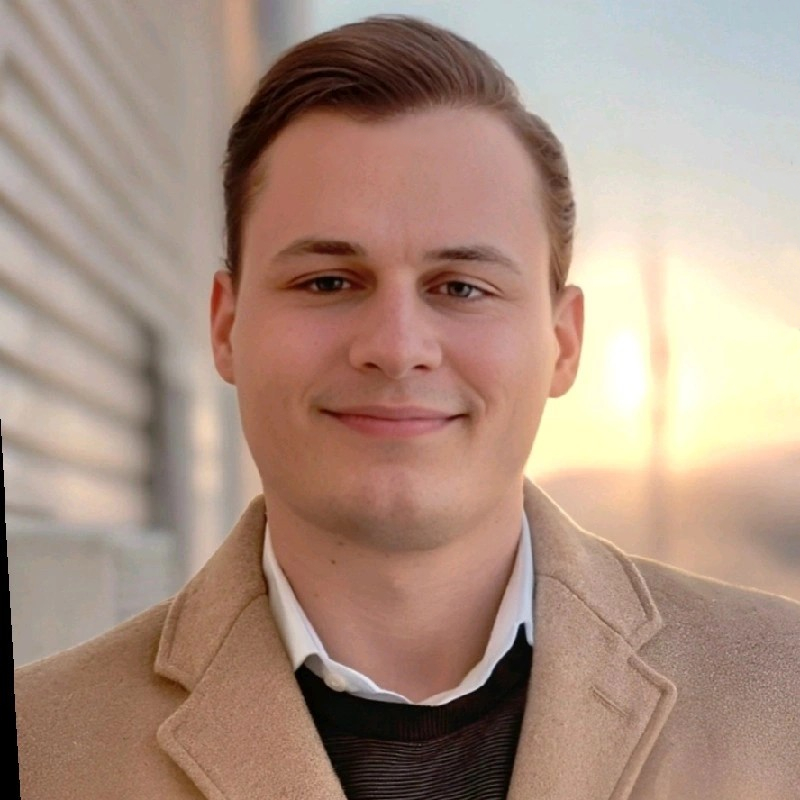
Tyler Ward
Visiting Assistant Professor
Dept. of Engineering Sciences
Morehead State University
Research Interests
-
Here's a brief reference list containing three papers relevant to this research topic. I found Liu et al.'s work [1] very interesting, which led to me exploring a similar vein of thought in my own papers [2, 3]. I am very eager to continue working on topics such as these.
- Liu, M., Zhang, H., Liu, M., Chen, D., Zhuang, Z., Wang, X., ... & Wang, Q. (2024). Randomizing human brain function representation for brain disease diagnosis. IEEE Transactions on Medical Imaging, 43(7), 2537-2546.
- Ward, T., & Imran, A. A. Z. (2025). Improving brain disorder diagnosis with advanced brain function representation and Kolmogorov-Arnold Networks. In Medical Imaging with Deep Learning.
- Ward, T., & Imran, A. (2026). ABFR-KAN: Kolmogorov-Arnold Networks for Functional Brain Analysis. arXiv preprint arXiv:2601.00416.
-
I've done a lot of work on this topic on the imaging front, you can find a lot of my work cited below [1-5] if you are interested. I've also included a couple of works [6, 7] by people I know who work on data-efficient federated learning, which is a technique I'm very interested in exploring in the future. Additionally, I've also included a paper [8] on differential privacy in medical AI, which I am interested in working with and exploring ways to make it more efficient.
- Ward, T. B., Moseley, A., & Imran, A. A. Z. (2026). Domain and task-focused example selection for data-efficient contrastive medical image segmentation Machine Learning for Biomedical Imaging, March 2026 Issue, 21-36.
- Ward, T., Owen, M. K., Coleman, O. K., Noehren, B., & Imran, A. A. Z. Autoadaptive medical Segment Anything Model. (2025). arXiv preprint arXiv:2507.01828..
- Ward, T., McFarland, B., Nozad, S., Arshad, T., Nebbache, H., Chen, J., ... & Imran, A. A. Z. (2025). Automated intraoperative lumpectomy margin detection using SAM-incorporated Forward-Forward Contrastive Learning. In Medical Imaging with Deep Learning-Short Papers.
- Ward, T., Wang, X., McFarland, B., Ahamed, M. A., Nozad, S., Arshad, T., ... & Imran, A. (2025). Detection of breast cancer lumpectomy margin with SAM-incorporated Forward-Forward Contrastive Learning. arXiv preprint arXiv:2506.21006.
- Ward, T., & Imran, A. A. Z. (2025, April). Annotation-efficient task guidance for medical Segment Anything. In 2025 IEEE 22nd International Symposium on Biomedical Imaging (ISBI) (pp. 1-4). IEEE.
- Mahanipour, A., & Khamfroush, H. (2026, July). From rules to predictions: Federated tabular learning with LLM reasoning. In BioNLP 2026 (pp. 970-980).
- Mahanipour, A., Imran, A., & Khamfroush, H. Towards memory-efficient foundation models in medical imaging: A federated learning and knowledge distillation approach. In The Second Workshop on GenAI for Health: Potential, Trust, and Policy Compliance.
- Ziller, A., Usynin, D., Braren, R., Makowski, M., Rueckert, D., & Kaissis, G. (2021). Medical imaging deep learning with differential privacy. Scientific Reports, 11(1), 13524.
- Bandela, S. R., Parthasarathy, S., & Garg, V. TWeddit: A dataset of triggering stories predominantly shared by women on Reddit. (2026). arXiv preprint arXiv:2601.11819..
- BN, S., Sherrill, A., Arriaga, R. I., Wiese, C., & Abdullah, S. (2026). Thousand Voices of Trauma: A large-scale synthetic dataset for modeling prolonged exposure therapy conversations. Advances in Neural Information Processing Systems, 38.
This is a research area that I haven't done work in yet, so the list of literature relevant to my interests is pretty light at this point. That being said, I found the following dataset papers interesting, and am actively exploring ways to leverage data like this for safe and responsible language model training.
- Jinan, U. A., Heidarikohol, N., Borst, C. W., Billinghurst, M., & Jung, S. (2025). A systematic review of using immersive technologies for empathic computing from 2000-2024. Empathic Computing, 1(1), 202501-202501.
To borrow the definition provided by the main journal in the field: "Empathic Computing is a rapidly emerging field of computing concerned with how to create computer systems that better enable people to understand one another and develop empathy. This includes the use of technology such as Augmented Reality (AR) and Virtual Reality (VR) to enable people to see what another person is seeing in real time, and overlay communication cues on their field of view. Also, the use of physiological sensors, machine learning and artificial intelligence to develop systems that can recognize what people are feeling and convey emotional or cognitive state to a collaborator. The goal is to combine natural collaboration, implicit understanding, and experience capture/sharing in a way that transforms collaboration."
As the co-director of MSU's Virtual Reality and Automation Lab, I am particularly interested in how empathic computing principles can be adopted to create software to assist users in recovery from traumatic events. Specifically, I am interested in the development of virtual and augmented environments for use in exposure therapy, alongside integration of physiological data and AI that can adapt the environments to the user's emotional state. As an example, consider a patient with agoraphobia being placed in a virtual crowd. If the user begins experiencing distress, physiological sensors could trigger an AI intevention that would adapt the environment to a more tolerable one for the user, as well as potentially triggering a human or agent-guided response to calm the user and ensure their comfort.
This is a very new research area for me, so until I flesh out the body of work that I'm familiar with, I will leave a review article on empathetic computing for reference.
- WIP