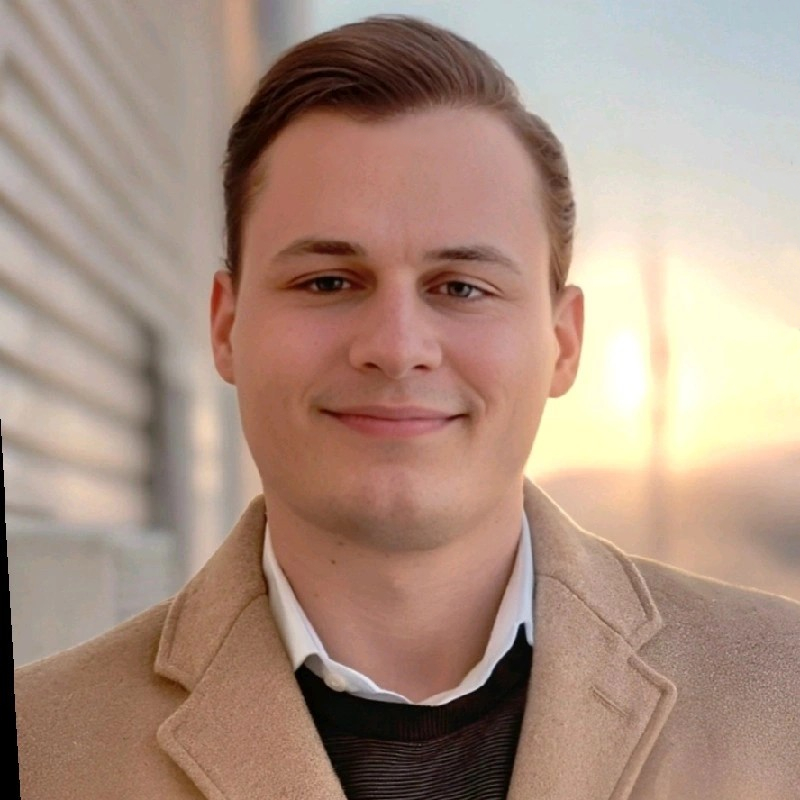
Tyler Ward
Visiting Assistant Professor
Dept. of Engineering Sciences
Morehead State University
Advising Philosophy
Given the many, many, many studies regarding the detrimental impact that toxic supervisory relationships in academia can have on students' mental health (seriously, fellow academics, we need to do better), I think it is very important to be transparent regarding my philosophy when it comes to advising students. Put simply, I abide very strongly by a comical version of the Golden Rule, which I define as "Don't be a Dick". A more thorough definition of my philosophy in the form of general musings on the state of academic research can be found below, as well as an outline for how I advise students.
General Musings
I saw this video a while back on TikTok by the lovely Sarah Fischer that I really resonated with, particularly her mantra of "there are no emergencies in academia":
As a product of it, I acknowledge that academia can at times be a very stressful environment, especially with the prevalence of the so-called "Publish or Perish" mindset. However, I am also a very strong believer that faculty should not allow themselves to project their own stress onto their students, and should avoid falling into the trap of constantly pushing to publish work that is not ready for publication or is of generally poor quality, simply for the sake of getting something published. I have known many people who have been pressured to publish such work, myself included, and to me, this type of mentality goes against everything that I think good science should be.
As I begin my first faculty position, I plan to avoid at all costs any action that may further facilitate what I view as a very harmful mindset. Instead, I choose to be a strong advocate for healthy work-life balances in academia, and the so-called "slow-science" movement that focuses on quality over quantity, deep reflection, and curiosity-driven research. This, I think, is much more aligned with what an academic should be, as well as being better suited to producing high-quality research and researchers that can go on to make meaningful contributions to their field of study.
What Working for Me Is Like
Day-to-Day Experience
The day-to-day experience of working as a researcher in my group is largely dependent on the preferences of each student. As a computer science researcher, I realize that the vast majority of the research done in my group can be done completely remotely. As such, I do not require that my students physically show up anywhere to work, although I can provide a lab space with a computer to any student who asks for one.
In terms of management style, I abide by a philosophy of servant leadership, which is the philosophy of serving others, sharing power, and prioritizing the personal growth and well-being of my team. From this definition, I hope the stark contrast to micromanaging is clear. At no point will I ever be breathing down any of my students' necks policing what they are doing. I am a strong believer in the capabilities and independence of each of my students, and only require that they meet with me once a week to go over their research progress for that week.
On the topic of meetings and research progress updates, I do try to take a very active role in the administration of the research done in my group. I never want to send any of my students off to do work with no guidance whatsoever, because it sucks to work under those conditions. To ensure this doesn't happen, I will pretty much always have mapped out prior to the start of any project exactly how I want the project to go in terms of deliverables and what the final outcome should be. This means that on my end, I do a lot of research throughout the process to ensure that I am knowledgeable enough about the topic to answer any questions my students may have. Each week, I will give very clear goals that I want accomplished by the next week, as well as guidance on how to do that. If a student is ever unclear on any of these expectations or run into trouble when trying to execute them, I encourage them to come to me for help, it is never a hassle. The student is of course free to pursue research avenues outside of the work that I assign if they find an interesting pathway to explore. I encourage this, it's part of gaining indpenedence as a researcher.
Publishing Our Work
Publishing is obviously one of the most important part of academia, and in my career I've found that it is one of the main stressors for academics, particularly if working towards a deadline. This makes sense, but personally, I don't want avoidable stress in my job if I can help it, and certainly don't want to push stress onto my students. As such, as a faculty I intend to avoid working on a deadline basis as much as possible.
Simply because a big conference (NeurIPS, CVPR, ICLR, ICML, AAAI, take your pick) is coming up does not mean work has to be submitted to it. I am not bound to any particular venue, and in fact I prefer submitting work to journals, which rarely have deadlines, and carry the additional benefit of rarely costing money, whereas the cost of conference attendance can be exorbitant. In my group, we conduct research for a project until the project is complete (i.e., we have proven or disproven our hypothesis), and only then will we start drafting a paper for publication. Once the draft is complete, we will first upload it to a preprint service (I prefer arXiv) so it is in the public domain, and only then when we start looking for venues, be it a conference or a journal, to submit to. This way, we are only submitting work that we are confident in and we can manage any sort of associated deadline with no stress, at our convenience.
Work-Life Balance and Boundaries
For whatever reason, it seems like having a poor work-life balance is just accepted as part of being an academic. This is dumb. It does not need to be this way. As someone who works at an institution that primarily services undergradates, I acknowledge that my students lead very busy lives outside of the work they do in my lab. As such, I will never send any e-mail or any form of communication outside of "normal" working hours, say between 8 AM to 6 PM. My students are more than welcome to e-mail me outside of those hours, but depending on what it's about, I may not respond until the next business day. This is just so everyone is set up to be able to turn their brains off outside of work and enjoy their lives. Additionally, I have absolutely no desire to have my students' cell phone numbers, and my students' will not have mine. I prefer to keep work communication solely in e-mail or in-person format, so as to not let work intrude into our personal lives.